Implants vs. bridges: how to choose what is right for you
Both restore missing teeth, but they age differently and demand different long-term care. Here is how we help patients decide.

Dr. Suneeta Veeramachaneni
2 August 2025 · 5 min read

When a tooth is lost, two of the most common replacement options are a dental implant and a fixed bridge. Both restore function and aesthetics, but they take different paths to get there.
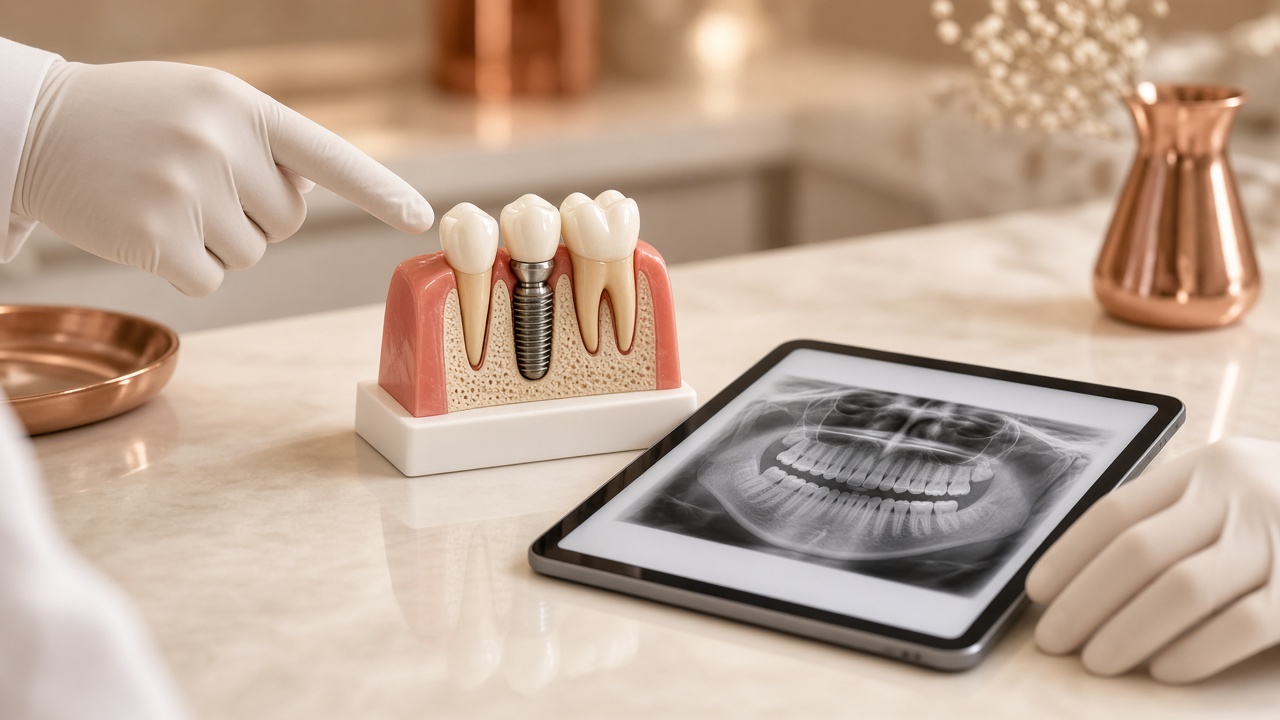
How an implant works
An implant replaces the root with a titanium post anchored in the jaw, then a custom crown is placed on top. Because the post stimulates the bone, the surrounding ridge stays healthier over time. The neighbouring teeth are left untouched.
“Because the post stimulates the bone, the surrounding ridge stays healthier over time.”
How a bridge works
A bridge instead uses the two adjacent teeth as anchors. The middle tooth is suspended between them. It is a faster, lower-cost path that suits patients who want to avoid surgery, and it can look excellent in skilled hands. The trade-off is that the anchor teeth need to be reshaped, and the bone underneath the missing tooth slowly resorbs.
How we decide together
We usually recommend implants when the neighbouring teeth are healthy, when bone volume is good, and when the patient wants the most long-lasting solution. Bridges remain a strong option when the adjacent teeth already need crowns, or when surgery is not preferred.
Written by
Dr. Suneeta Veeramachaneni, DDS, University of California, San Francisco
More about Dr. Suneeta Veeramachaneni, DDS, University of California, San Francisco